


How to support children’s motivation and focus during homework time
At homework time at home, many parents tell me they feel a certain heaviness: negotiations, sighs, lack of enthusiasm, difficulty staying focused. And yet, it’s not always a matter of willpower or opposition.
Before going any further, I want to add an important nuance.
If homework is already going well at home, your child is fairly motivated and the routine works… keep going. There’s nothing to fix when things are going well.
When motivation fades: a small adjustment can help
The ideas I’m sharing here are especially helpful when a child feels unmotivated, when homework still sounds like: “Oh no… more work, I want to play!” In those moments, making a small adjustment — without turning everything upside down — can be enough to reignite motivation.
Some children will actually enjoy this type of approach more often. Maybe because they’re younger, more immature, or simply because after a full day at school, play and movement take over. For others, the need is even clearer: they are children who need to move in order to focus.
Why movement truly helps learning
Did you know? In the brain, movement acts like a little bridge that also activates attention. That’s exactly why we often feel more focused after exercising… or even after a simple walk.
This is also why, both at home and at school, it’s recommended not to completely restrict movement — especially for children with attention difficulties. When a child moves, they unconsciously stimulate learning through movement. Their body knows what it needs.
On the flip side, if a child is forced to stay still for too long, their attention can shut down despite their best efforts… and their mind will start to wander.
👉 Moving is sometimes like pressing the FOCUS button.
Of course, not every setting allows for free movement. There’s an environment to respect and sometimes other people around. But at home, during homework time, we can allow ourselves more flexibility.
And let’s not forget this: it’s often better to accept that a child who needs to move takes a short break to release energy, move around, and then come back to homework, rather than forcing them until exhaustion.
Even for teens who are heavily solicited by schoolwork, a walk or a movement break when attention drops can make a real difference.
Here are now 4 very simple ideas, with no complex equipment, to use when things start to feel stuck.
1. Post-its in motion
A playful and ultra-adaptable idea.
- Have the child write on post-it notes, then ask them to move around to stick them somewhere: walking, jumping, going up or down stairs, etc.
- You can also write answers yourself (additions, subtractions, multiplication tables, divisions) on post-its placed on the wall. Ask a question, and the child must move to find the correct answer.
- Depending on age and level: sounds, letters, numbers, shapes, country capitals, English words, vocabulary, etc.
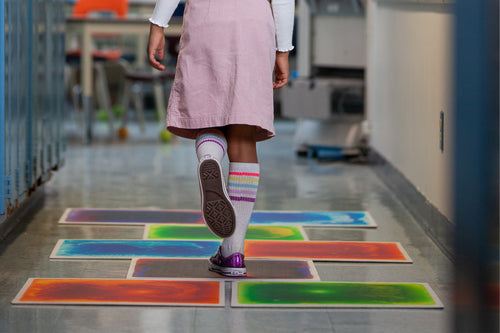
Obstacle course variation: Place papers on the floor to create a small course requiring big steps, balance, jumps, or climbing one step at a time. On each paper, you can:
- read a word,
- answer a quiz question,
- review verbs (e.g., to like, 2nd person plural), etc.
2. The whiteboard, window, or wall
The idea here is to let a child who needs to move work while standing.
- Write on a window with dry-erase markers
- Use a whiteboard
- Tape a large sheet of paper to the wall
Simply being on their feet allows them to stretch, sway a little, and creates a sense of play rather than a rigid structure.
3. The exercise ball (or variations)
The child works at the table, but sits on an exercise ball: they can gently bounce, sway, and find their balance. Using an inflatable cushion like the Disc’O’Sit is also a very interesting option for home and school.
Simple variation (no ball):
- Work on their knees on a cushion at the coffee table
- Or, when the weather allows, do homework outside
Just stepping away from the “dining table or desk” setup makes the activity feel less formal and helps many children. On a cushion, a child who needs to move can wiggle, stand up, change positions… while staying engaged.
4. Floor mat or trampoline
No matter what’s being reviewed, you can set up a simple agreement with your child.
For example, in Grade 1, my son had sight words to read. Toward the end of the year, to motivate him, we worked on the trampoline:
- 5 words read = 5 jumps
- 10 words read = 10 jumps
It was motivating, fun, and it created connection… instead of turning homework into a battle.
Bonus – Moving to better regulate everyday behaviour
We often talk about movement to support attention and learning through movement… but its impact on behaviour is just as important.
Evenings, weekends, or during holidays, some families are less inclined toward physical activity or outdoor play — and that’s okay. But honestly, it often doesn’t help.
Families who are used to moving notice it right away: on rainy days spent indoors, the difference is obvious.
Why? Because being indoors often means:
- more proximity,
- smaller spaces,
- more noise,
- fewer opportunities to release energy.
And all of that almost automatically creates… more conflict and, therefore, more behaviour management.
The reality is that you and I both have a certain amount of energy to release each day. If that energy isn’t released through movement, it will come out another way:
- excessive excitement,
- fights between siblings,
- provocation,
- intolerance and impatience — in both children and parents.
In short, energy that isn’t released through movement will inevitably look for an outlet. And very often, that outlet shows up as challenging… or more aggressive behaviours.
👉 In other words, integrating learning through movement into everyday life is doing yourself a huge favour.
For you, move in a way that suits you:
- a sport you enjoy,
- a regular workout, even a short one,
- a simple walk.
For children, same principle:
- off we go, outside when possible,
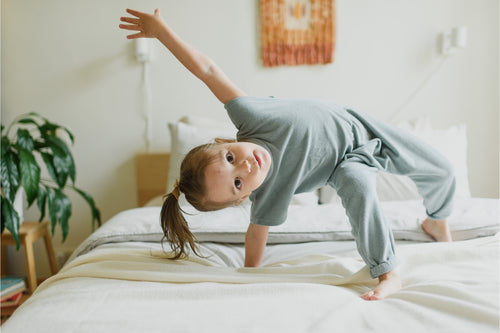
- otherwise indoors: dancing, a gentle pillow fight on the bed, an inflatable punching bag, stationary bike, cartwheels, mini workouts… whatever works — it needs to come out 🙂
By activating their bodies this way, you’re supporting not only better behaviour, but also a stronger ability to follow instructions. The happy hormones do their job… just like they do for you when you move too.
In short, movement has wonderful benefits.
⚠️ Important nuance: because movement BOOSTS energy, avoid overly stimulating activities in the hour before bedtime. Otherwise, falling asleep may be much more difficult.
In summary
Moving during homework — and in everyday life — doesn’t need to be complicated, structured, or perfect. It’s about small touches, adjusted to your needs, to bring back enjoyment, lightness, attention… and a better family atmosphere into daily life.








Leave a comment